
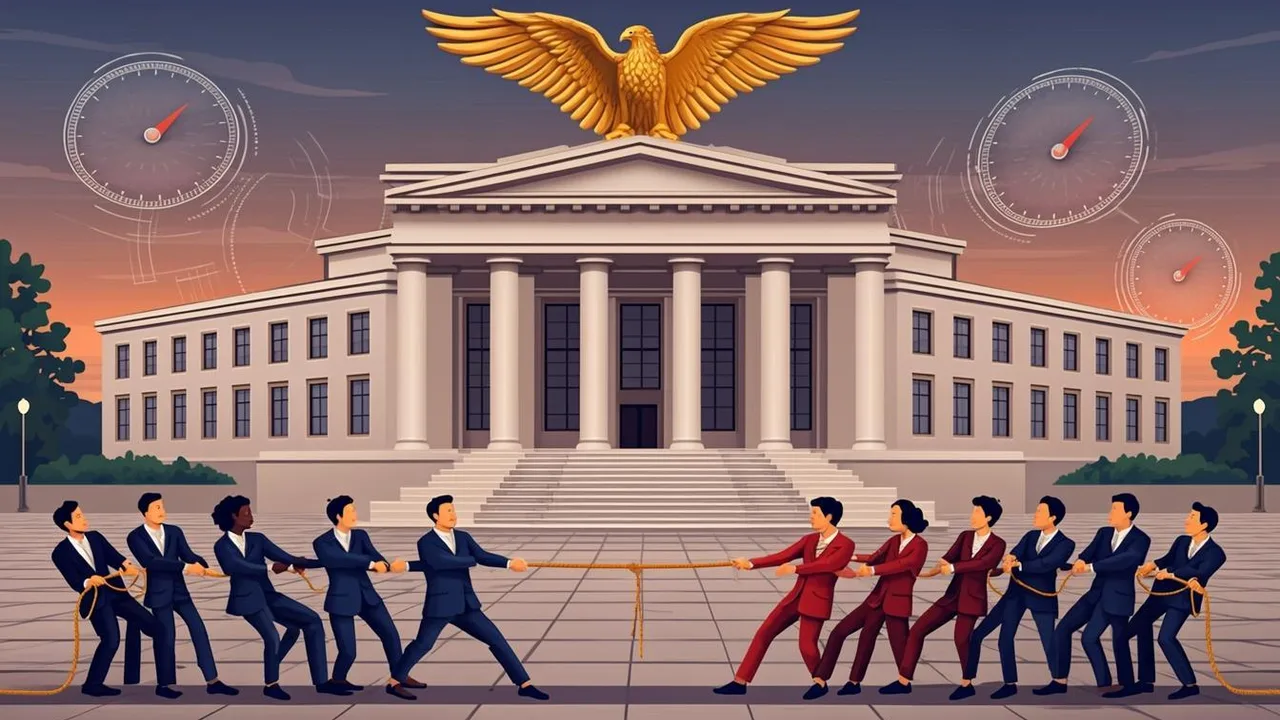
When central bankers describe a soft landing, they paint a picture of near-miraculous precision: inflation gliding back to target while growth stays positive, unemployment rising only gently, and the expansion surviving its own medicine. It is the monetary policy equivalent of landing a jet on a runway still being built — and for the people occupying the economy's seats, the experience is smoother than a crash, but not turbulence-free.
For workers, the term is quietly misleading. A soft landing is not the absence of a slowdown; it is a slowdown with the sharpest edges filed off. Job creation cools, vacancies disappear, bargaining power shifts back toward employers, and real wage growth — the number that determines living standards — compresses. None of that registers as a recession in the headlines. All of it registers in household budgets.
This analysis unpacks what a genuine soft landing means for employment and pay, why history suggests such episodes are rare and never painless, and which signals will reveal whether the current one is living up to its name as 2026 gives way to 2027.
Key Takeaways
- A soft landing means inflation returns to target without a recession — but "without a recession" is not the same as "without pain": unemployment typically rises modestly, often by about one to two percentage points from its low, before stabilizing.
- Wage growth slows to near or slightly below the inflation rate in typical soft landing episodes, meaning real purchasing power stagnates for many workers after the earlier cost-of-living squeeze.
- The slowdown arrives unevenly: rate-sensitive sectors like housing and construction adjust first, while essential services and healthcare hold up better.
- The indicators that matter are payroll growth, job openings, quit rates, and average earnings relative to inflation — not the headline unemployment rate alone.
What a Soft Landing Actually Requires
Start with the engineering problem. Central banks cool inflation by raising interest rates, which raises borrowing costs, which suppresses demand for houses, cars, factories, and eventually labor. The entire exercise rests on a chain of delayed effects: policy moves today influence spending months from now. Land the tightening too softly, and inflation becomes entrenched; too hard, and the slowdown acquires momentum of its own.
The narrowness of the corridor explains why soft landings are so rare. Central banks aim at a moving target with an instrument that works with long and variable lags, using data that describes the recent past. The honest framing is not that a soft landing is impossible, but that it requires both skill and luck — and luck has usually run out before the job was finished.
What distinguishes a soft landing from a hard one is not whether unemployment rises — it almost always does — but how far and how fast. A hard landing is a sudden, self-reinforcing contraction in which layoffs trigger falling spending, which triggers more layoffs. A soft landing is the same mechanism, throttled: hiring slows before firing starts, and the rise in joblessness is measured in tenths rather than points.
The Historical Record: Rare, and Never Entirely Painless
The canonical example is the American tightening of the mid-1990s, when policy restraint slowed growth without a recession — though even that celebrated episode featured sluggish job creation and a bond market convulsion along the way. Most other tightening cycles have ended in recession, and analysts caution that the sample of genuine soft landings is too small to treat the pattern as a playbook rather than coincidence.
What the record does show clearly is the labor market signature of successful disinflations. Job openings fall first, quit rates decline as workers sense the shift, and only then does unemployment drift higher — often by about one to two percentage points from its trough before stabilizing. Wage growth, hot during the tight phase, decelerates toward, or slightly below, the rate of inflation. For workers who spent the inflationary years losing ground to prices, the catch-up phase ends prematurely: purchasing power stabilizes, but does not recover what was lost.
That framing — the soft landing as an interrupted recovery of living standards — is often missing from celebratory coverage. It is the difference between the economy's perspective and the household's.
How the Slowdown Reaches the Labor Market
The transmission works through channels that are easy to observe once you know where to look. The first is vacancies: businesses respond to higher borrowing costs and softer demand by posting fewer openings long before cutting staff. A declining vacancy count alongside stable payrolls is the classic early signature of a soft landing — hiring freezes in place of layoffs.
The second channel is churn. In tight markets, workers quit at high rates, confident of finding something better, and job switchers command the largest wage gains. As conditions cool, quits fall, switchers lose leverage, and wage growth converges toward the slower rate available to job stayers. Desks tracking compensation report that the post-pandemic premium for switching jobs has narrowed considerably.
The third channel is composition. Total employment can keep rising even as the mix deteriorates: fewer full-time roles in high-paying, cyclically sensitive industries, more part-time and lower-wage service positions. Headline payrolls stay positive; aggregate hours tell a cooler story.
Sectors Feel It Differently
A soft landing is an averages game; no household experiences the average. Interest-rate-sensitive industries — residential construction, real estate brokerage, durable goods manufacturing, and finance itself — absorb the first and sharpest impact of tighter policy. Housing-linked employment, from framers to mortgage processors, contracts early and visibly.
Growth-oriented sectors adjust differently: technology and professional services tend to slow hiring rather than cut deeply, pausing expansion plans and letting attrition do the work. This can make the tech labor market feel abruptly colder — longer searches, more selective employers — even as aggregate unemployment barely moves.
The resilient core is essential services: healthcare, education, utilities, and much of the public sector, where demand is insensitive to rates and staffing shortages are structural. Workers in these fields experience a soft landing mostly as easing inflation rather than easing labor demand — the closest thing to a painless outcome on offer.
The Wage-Price Unwinding
The heart of every soft landing is the dismantling of the wage-price spiral — or, more precisely, the expectation loops that drive one. When households and firms expect high inflation, workers demand larger raises, firms raise prices to cover them, and the expectation validates itself. Breaking the loop means convincing millions of decision-makers that inflation is truly falling — which is why the last mile of disinflation is famously slow.
For workers, the unwinding feels asymmetric. Prices that jumped during the inflationary surge rarely fall back; wage growth that lagged prices rarely catches up. The soft landing declares victory when nominal wage growth and inflation converge at moderate levels — but convergence at that level locks in the real income losses accumulated along the way. That asymmetry explains why an economy can be technically thriving on the very day its voters feel poorest.
FAQ
Does a soft landing mean unemployment stays at its lows?
No. In historical soft landing episodes, unemployment typically rises modestly — often around one to two percentage points from its lowest point — before stabilizing. The defining feature is that the rise is gradual and limited rather than sudden and severe.
Will real wages keep growing during a soft landing?
Only modestly, at best. Nominal wage growth generally slows to near or slightly below the inflation rate as the labor market cools, which means real purchasing power roughly stagnates after the losses of the inflationary period. Workers who switched jobs early in the cycle typically fared better than those who stayed put.
Which workers are most exposed?
Those in rate-sensitive and cyclical industries: residential construction, real estate, durable goods manufacturing, and finance. Workers in healthcare, education, and essential services face the least labor market risk, though they share the same inflation experience.
How can I tell if the soft landing is failing?
The clearest warning signs are a rising pace of initial jobless claims, involuntary part-time employment climbing, and layoffs spreading from rate-sensitive sectors into services. If payroll growth turns negative for consecutive months while unemployment rises quickly, the landing is hardening.
The Bottom Line
A soft landing is a genuine achievement and a real improvement over the alternative — but it is a macroeconomic triumph, not a household one. For the labor market, it means the end of the worker-favoring period: fewer openings, less leverage for job switchers, slower wage growth, and a modest rise in unemployment that never quite reaches recession territory. For most workers, the practical translation is a return to normal — one in which raises require justification again and searches take longer.
The essential discipline is to watch the right gauges. The unemployment rate is a lagging indicator that flatters the present; vacancies, quit rates, claims, and real wage trajectories describe the landing in real time. If those indicators converge gently — openings falling while payrolls grow, wage growth settling near inflation — the landing is on course. If they break in sequence, it will not matter what we call it.
For workers, the strategy under a soft landing is the mirror image of the strategy under a boom: build leverage before you need it. Skills, networks, and savings are worth accumulating precisely in periods like this one, when the market quietly stops handing them out for free.



Comments(0)
Share your thoughts. Comments are moderated and links are not allowed.
No comments yet. Be the first to share your view.
Add a comment