
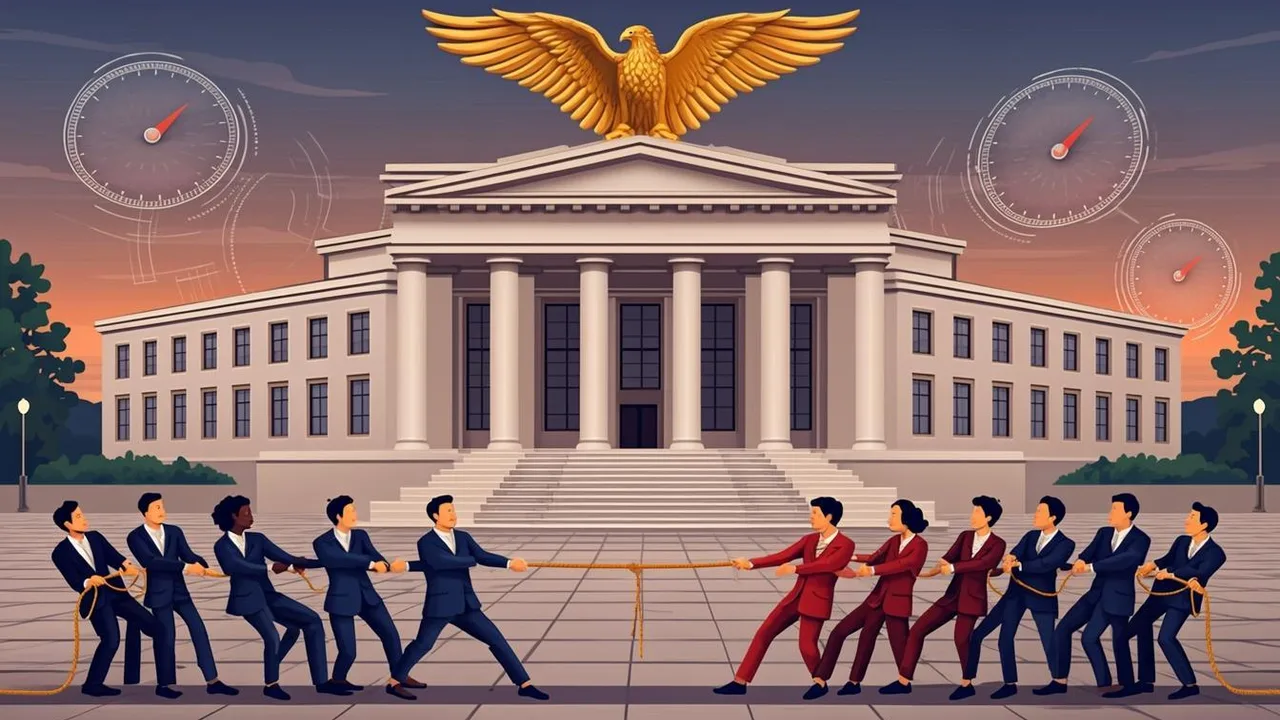
For millions of American households, Thursday, October 29, 2026 brought a fresh reminder that monetary policy is not an abstraction — it is a line item in the family budget. As MarketWatch reported today, borrowing costs are expected to keep climbing for Americans carrying credit-card balances, after the Federal Reserve's September rate hike and with another increase now projected for December. For anyone revolving a balance from month to month, every policy meeting has become a direct and almost immediate hit to the cost of their debt. The moment has even changed the advice desk: MarketWatch's personal-finance columnists now frame balance-transfer cards as the "best weapon" for fighting debt while rates climb — a striking endorsement for a product long marketed as a perk. The story of American credit-card debt in 2026 is the story of monetary-policy transmission with the lag stripped out, and it is converging fast on the December meeting, where another projected increase would raise the price of borrowing yet again.

How a Fed Decision Reaches Your Card Statement
The distance between a policy meeting in Washington and a credit-card statement in a kitchen drawer is shorter than most borrowers realize. When the Federal Reserve moves its benchmark rate, the change propagates through the financial system in a chain: the policy rate shifts first, the prime rate that banks quote follows almost mechanically, and the variable annual percentage rates on most credit cards — contractually tied to that prime rate — adjust with it. No announcement from the card issuer is required. No negotiation occurs. The higher rate simply appears.
This is why card borrowers sit at the sharpest end of monetary tightening. A homeowner with a fixed-rate mortgage may go years without feeling a single hike. An auto loan contracted in the past keeps its original terms. But the standard credit card is a floating-rate instrument wearing a plastic disguise, and every increase the central bank has delivered — including September's — lands on card balances in short order.
The mechanism also explains why officials keep pulling this particular lever even when it stings. Policymakers still fighting inflation are working through the last-mile problem of reaching final inflation targets — the stubborn final stretch in which price pressures resist easy fixes. Rate increases are the instrument, and floating-rate consumer debt is where that instrument bites fastest. That is not an accident of design; for a central bank trying to slow borrowing, it is the point.
The Long Lag That Catches Borrowers Off Guard
Economists like to say monetary policy works with long and variable lags. Where credit cards are concerned, that phrase needs a caveat: the lag into card rates is short, but the lag into household finances is long — and the mismatch between the two is where borrowers get hurt.
The short part is mechanical. The policy rate moves, the prime rate moves, card APRs move. The long part is human. A household carrying a balance experiences rising rates not as a single event but as a slow accumulation — each hike adds another layer of cost onto a balance that, for many families, has been revolving for years. Because the minimum payment changes only gradually, the damage is easy to miss in any given month. Then one month the arithmetic becomes unmissable: a growing share of each payment is consumed by interest, and the principal barely shrinks.
That is the compounding trap of a sustained tightening cycle. September's hike did not arrive in isolation. It stacked on top of every increase that came before it, and a projected December increase would stack on top of September's. Cardholders are not paying for one meeting; they are paying for the whole sequence. This is also why the pressure feels so persistent: as long as core inflation stays sticky even as goods get cheaper, the case for keeping policy restrictive remains intact — and with it, the weight on every floating-rate balance in the country.
Stress Signals Are Stacking Up in Household Budgets
No single data point defines household stress, but the pattern building across American budgets is hard to miss. Balances are being carried for longer. Payments are absorbing a larger share of monthly income. The cushions families built in earlier years are being drawn down, and the credit card — the most expensive form of everyday borrowing — is increasingly the bridge spanning the gap between income and outgo.
The psychology tracks the arithmetic. Households describe feeling squeezed long before they cut spending, and sentiment surveys often sour well before cash registers show it — a gap examined in why consumer confidence and actual spending keep diverging. That divergence matters for the economy as a whole, because consumption is the largest component of growth, and a consumer who feels poor eventually spends like one.
It matters even more in a rising-rate environment, because the stress is not distributed evenly. Borrowers who pay their balances in full each month experience rate hikes as a non-event; the burden falls almost entirely on revolvers — households who carry debt month to month, and who are disproportionately lower-income. For them, each projected increase is not a macroeconomic abstraction but a direct subtraction from whatever is left after the bills are paid. The politics of the next downturn, whenever it comes, will be shaped by which of these two groups policymakers were watching when they set rates.
The Balance-Transfer Lifeline, Explained
Enter the strategy that MarketWatch's personal-finance columnists now call the "best weapon" for borrowers fighting debt while rates climb: the balance-transfer credit card. The mechanics are simple in concept. A borrower opens a new card, moves an existing balance onto it, and receives an introductory period during which the rate charged on that transferred balance is low or zero. The point is not magic — it is a head start. Every payment made during the introductory window goes toward principal rather than interest, which means debt that might take years to dent at a high standard rate can be attacked directly.
The endorsement matters because of who is giving it. Personal-finance columnists tend to be a conservative lot when it comes to debt advice, long favoring the unglamorous virtues of budgets and emergency funds. When that community collectively reframes a credit-card product as a weapon — the best one available — it signals how much the ground has shifted. In a world where carrying a balance keeps getting more expensive, the calculus of repayment changes: the mathematical case for moving debt somewhere cheaper has rarely been stronger.
Used with discipline, the tool works as designed. The borrower treats the introductory period as a deadline rather than a vacation, divides the balance by the months available, and pays with the urgency of someone who knows the clock is running. The strategy is not sophisticated. It is simply the rare financial product that, in this environment, genuinely tilts the field back toward the household.

The Traps Hiding Inside the Lifeline
If the balance-transfer card is the best weapon available, it is also one that frequently backfires in its owner's hands. The traps are well worn in the personal-finance literature, and they begin at the moment of transfer. Most balance transfers carry an upfront fee based on the amount moved. That fee is worth paying when the arithmetic works — and it is exactly what makes a transfer pointless for a balance the borrower cannot realistically clear within the introductory window.
The second trap is time itself. Introductory periods are exactly that: introductory. When the window closes, the rate on any remaining balance reverts, often sharply, and the borrower who transferred without a repayment plan simply finds the old problem wearing a new logo. The third trap is behavioral. A freshly emptied old card is an invitation to spend, and households that transfer a balance only to refill the original card end up worse than where they started: two balances instead of one.
There is also a subtler cost. Opening new credit affects a borrower's credit profile, and chasing successive transfers — leaping from one introductory offer to the next — can degrade the very score that qualified them for the good offers in the first place. The weapon works only as part of a plan: a fixed repayment schedule, a freeze on new spending, and an honest accounting of whether the underlying budget gap has been closed. Without those things, the balance-transfer card is not debt relief. It is debt relocation.
Bank Profits Meet the Consumer Squeeze
On the other side of every card statement stands an issuer, and the tightening cycle is transforming issuer economics too. Card lending is among the most profitable forms of consumer credit in normal times — priced at premium rates, with interest income that rises automatically when benchmark rates climb. In a period of successive hikes, the spread mechanics favor lenders: funding costs adjust slowly, while card APRs reprice almost instantly.
But the squeeze that burdens households eventually burdens lenders through a different channel: losses. The profitability of card lending rests on borrowers staying current. When a growing share of income goes to interest, some borrowers begin to slip — payments arrive late, then stop, and write-offs follow. A lender can enjoy rising spreads and deteriorating credit at the same time, and the second eventually devours the first. Managing that trade-off — how far to tighten credit standards, how aggressively to work with struggling borrowers — has become the central strategic question for consumer banks in this cycle.
The tension is visible at the systemic level as well. Recent years have seen global debt at record levels, and household revolvers are one piece of a much larger credit stock that has grown more expensive to service everywhere at once. Banks that tighten too hard risk starving the consumer spending that drives the economy — and their own loan books. Banks that stay loose risk absorbing the losses the squeeze produces. There is no setting on this dial that pleases everyone, which is precisely why the December projection is being watched on trading floors as intently as at kitchen tables.
What a December Hike Would Mean for Household Budgets
Markets project another rate increase in December, as MarketWatch's rate coverage today noted, and if it arrives, its timing will land with particular weight. December sits in the heart of the holiday spending season — the time of year when budgets are already stretched and when, traditionally, many households lean on credit cards to bridge the gap between festive intentions and festive budgets. A hike that raises borrowing costs precisely when balances swell multiplies its own effect.
The first-order arithmetic is straightforward: higher APRs mean every carried balance costs more each month, minimum payments drift upward, and the share of income devoted to servicing debt ratchets again. The second-order effects are slower but deeper. Households respond to rising debt-service burdens by cutting discretionary spending — travel, upgrades, dinners out — which feeds through to the businesses that depend on that spending, and from there to their hiring. A consumer squeeze, given time, becomes an economy squeeze.
The meeting itself is a bigger event than its name suggests. Policy decisions in December will ripple through asset prices worldwide, much the way central bank meetings move currency markets and every market connected to them. For card borrowers, though, the transmission is uniquely direct. Equity investors may shrug at the marginal move; a household watching its card APR climb does not have that luxury. December, in that sense, is not just the next Fed meeting on a calendar. It is the next line item on a statement.
What Exposed Borrowers Can Do Before December
With a projection on the calendar rather than a certainty, the weeks before the December meeting are, for cardholders, a window — and windows are for acting, not watching. The first move is triage: knowing exactly what is owed, at what rate, and how each payment splits between interest and principal. Borrowers who have never checked their APR are, in the current environment, subsidizing their own surprise.
The second move is sequencing. Not all debt is equally expensive, and paying off the cheapest balance first while the costliest one compounds is the most common — and most expensive — household error. Attacking the highest-rate balance first, whatever its size, is arithmetic rather than advice. The third move is to stop the bleeding at the source: borrowing costs that keep climbing punish every new purchase left revolving, which argues for cash or debit for discretionary spending while a balance remains outstanding.
The fourth move, for those who qualify, is the one the columnists are championing: evaluate a balance transfer honestly — the fee, the introductory window, the revert rate, and a repayment plan that fits the calendar. Treated as a bridge, it can save a household real money; treated as a reprieve, it merely relocates the problem. None of these steps requires financial sophistication. They require only the recognition that in an environment of climbing rates, time itself carries a price — and that price is rising.
What Happens Next
The trajectory for American card borrowers is unusually legible. Borrowing costs are expected to keep climbing, as MarketWatch reported today, with September's hike delivered, October's pause behind it and another increase projected for December. The genuine uncertainties are how much more stress the household sector can absorb before the damage shows up in spending data rather than just in sentiment, and whether the projected December move arrives as expected.
Watch three things from here. Watch the December meeting: a delivered increase versus a skipped one will set the marginal cost of every revolving balance into next year. Watch the advice cycle: when personal-finance columnists collectively rebrand balance-transfer cards as the "best weapon" available, it signals both how sharp the squeeze has become and how mainstream the defensive response now is. And watch the gap between what consumers say and what they spend, because that gap is where the next turn in the economy tends to announce itself first.
For households carrying balances, the practical conclusion is blunt: the era of cheap revolving credit is not returning on any schedule that helps them, and the cost of carrying debt passively compounds monthly. The tools to fight back exist, and the window before December is open. In credit-card arithmetic as in most things, the borrowers who move early pay the least.



Comments(0)
Share your thoughts. Comments are moderated and links are not allowed.
No comments yet. Be the first to share your view.
Add a comment