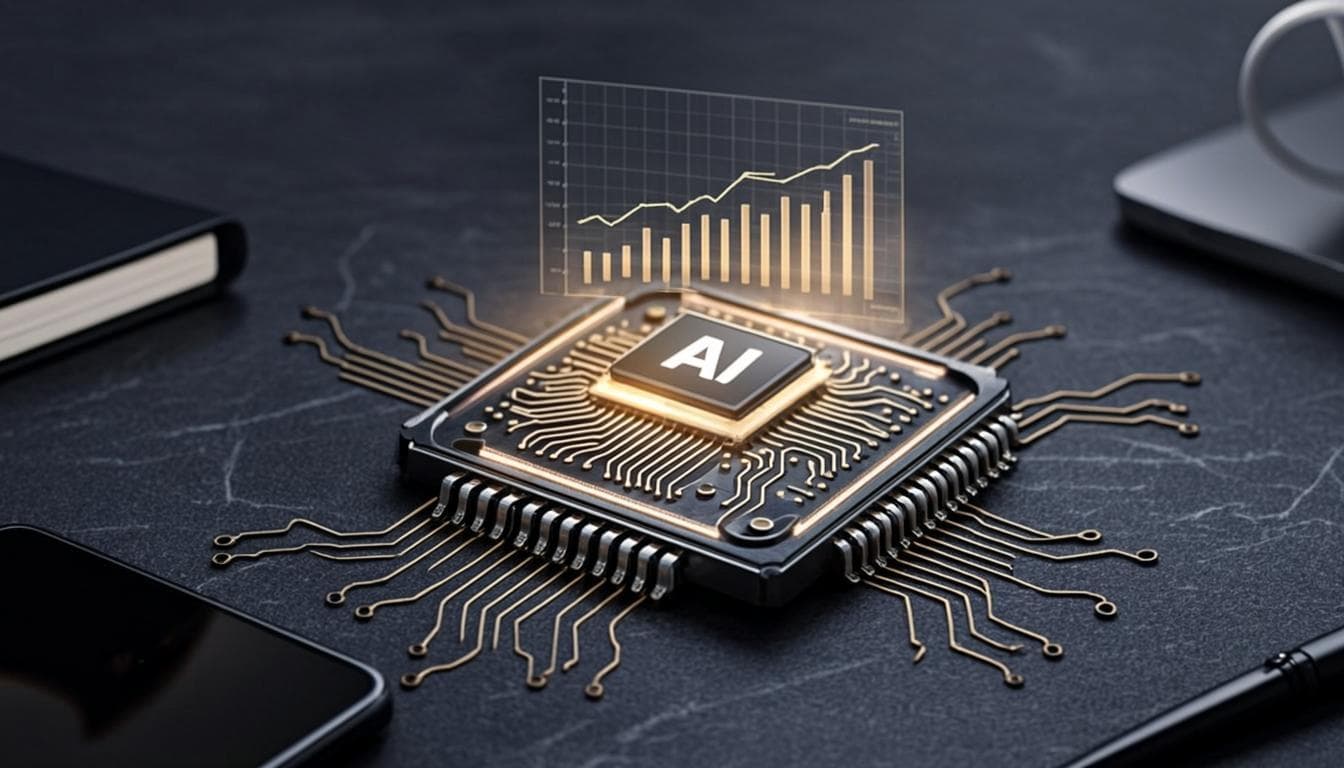
The chip war just got personal — and markets noticed immediately. Nvidia chief executive Jensen Huang has been caught up in a reported Chinese spy probe, according to Investing.com, a headline that landed late in Thursday's session and sent AI stocks sliding as investors scrambled to price a risk almost nobody had on their radar. The report, published on the evening of Thursday, October 29, 2026, remains thin on specifics, but that hardly mattered to traders. In a market where one company has become synonymous with the entire artificial intelligence boom, even an unconfirmed report touching its chief executive was enough to rattle the whole complex. The selloff was swift and broad, dragging down shares across the AI supply chain and reminding everyone involved that the sector's biggest risks are no longer measured in quarterly earnings. What follows is a closer look at what we actually know, why this moment marks a new and uneasy phase in the US–China technology conflict, and what it means for investors, boards, and the enterprises that have built their AI roadmaps on Nvidia's silicon.

What we know — and what we don't
According to Investing.com, Nvidia chief executive Jensen Huang has been caught up in a reported Chinese spy probe. That single sentence is, for now, essentially the sum of the hard information available, and the emphasis belongs on the word "reported." As of this evening, the report itself is the story: no official confirmation has arrived from either government, and the exact nature of the probe — what it concerns, who is conducting it, and how the Nvidia chief executive fits into it — remains unclear.
Markets did not wait for clarity. AI stocks slid on the news, per Investing.com, with the selling spreading well beyond Nvidia itself to the broader constellation of chipmakers, server builders, and AI-linked software names that trade in the company's gravitational field. That breadth is the first analytical clue about what actually happened on Thursday: investors were not merely repricing one executive's legal situation. They were repricing the geopolitical standing of the entire AI hardware trade.
The gap between what is known and what is feared is where all the interesting questions live. Is this a targeted action with teeth, an early-stage inquiry that may never mature, or noise that fades within a news cycle? Nobody outside the story knows yet — and perhaps not everyone inside it does either. Responsible analysis starts by holding that uncertainty openly rather than filling it with confident-sounding invention.
The chip war enters personal and legal territory
The US–China technology conflict has for years been fought with institutional weapons: export controls, licensing regimes, entity lists, and tariffs. Companies have been the combatants; executives have mostly watched from the boardroom. A reported probe that entangles the most recognizable face of the AI boom — a chief executive who has personified his company's extraordinary rise — would mark an escalation of kind, not merely of degree. As we explored in Why Chip Supply Chains Became National Strategy, semiconductors stopped being an ordinary industry governed by ordinary commercial rules some time ago. What is new is the suggestion that the conflict's legal dimension may now reach into the leadership of the sector's defining company.
If the report is accurate in its essentials, the message would be unmistakable: no individual, however commercially indispensable, is insulated from the technological cold war. That has consequences far beyond one man's circumstances. It changes how boards assess executive exposure in politically sensitive industries, how general counsel draft contingency plans, and how investors discount even the strongest franchise when its leadership sits at the intersection of two rival powers' strategic priorities.
Escalation into personal and legal territory, if confirmed, would convert an abstract geopolitical overhang into a concrete, nameable risk — and markets price the concrete far more brutally than the abstract. Thursday's slide can be read as the market performing that conversion in real time, repricing a diffuse worry into a specific one with a face attached.
Export-control déjà vu
For semiconductor investors, Thursday's slide carries a familiar sting. The industry has sat at the epicenter of US–China strategic competition for years, and every previous round of restrictions — on sales, technology transfer, and market access — arrived as a shock that battered chip shares before the dust settled. The pattern has become almost ritual: a policy headline lands, semiconductor stocks sell off hard, analysts spend days mapping second-order effects, and then the sector rebuilds its valuation on the strength of underlying demand.
Today's news rhymes with that history but changes its key. Past shocks were about commerce — which products a company could sell, to whom, and through which channels. This one, if the report holds, is about legal jeopardy attached to a specific human being. Commercial shocks can be modeled: revenue at risk, market segments lost, licensing pathways that eventually reopen. Personal and legal exposure resists that kind of spreadsheet treatment, which is precisely why the market's instinct was to sell first and ask questions later.
There is a crueler irony at work, too. Nvidia's business has been shaped more than most by the existing architecture of technology restrictions, and its leadership has spent years navigating the narrow corridor between Washington's rules and Beijing's expectations. A company already forced to choreograph its global strategy around two governments now finds its chief executive personally enmeshed in the very conflict he has spent a career trying to manage. Déjà vu, this time, comes with a twist that no earnings model captures.
One company, one man: the concentration problem
The AI economy has a concentration problem, and it is uncomfortable to say out loud. An enormous share of the world's most advanced AI systems depends on accelerators designed by a single company, and that company's public identity is inseparable from its chief executive. Jensen Huang is not merely Nvidia's top manager; he is its chief salesman, its technological compass, and — in the eyes of many investors — the single most consequential individual in the commercial AI ecosystem. That is an extraordinary asset in calm markets and an extraordinary liability in turbulent ones.
Key-man risk of this magnitude is rare in public markets, and boards are judged by how well they have prepared for it. As our piece on CEO Succession Planning: The Silent Risk Investors Ignore explains, succession planning is one of those governance questions markets ignore right up until the moment they cannot. Today's report forces the issue into the open — not because any leadership change is implied, but because investors must now price the possibility that the company's most valuable human asset operates under a geopolitical shadow of unknown length and severity.
The deeper issue is structural. An industry that concentrated its hardware supply in one company, and that company's public story in one person, purchased speed and coherence at the cost of resilience. Thursday's selloff is a reminder of how quickly that trade-off can invert when the news touches the exact point where the concentration is greatest.
Policy shocks now move chips faster than earnings
Not long ago, semiconductor stocks traded primarily on the industry's famously cyclical fundamentals: capital-spending cycles, inventory swings, and unit demand. Earnings season was the event; policy was background noise. That hierarchy has flipped. In today's market, a single unconfirmed report about one executive can move the AI complex faster than most earnings releases, because policy risk now sits at the center of every semiconductor thesis rather than in its footnotes.
The asymmetry is easy to understand. Strong earnings confirm what investors already believe about AI demand; policy shocks can redraw the boundaries of the business itself. A company can execute flawlessly — winning customers, expanding margins, hitting every commitment — and still watch its narrative whipsawed by a geopolitical headline it cannot control. When the moving parts of a thesis are mostly exogenous, markets stop paying for execution and start charging for exposure.
That dynamic also explains why selloffs like Thursday's tend to be sharp but shallow in information content. They reflect forced repositioning more than fresh analysis — a distinction worth keeping in mind alongside the themes we examined in What the Volatility Index Is Really Telling Us About Market Complacency. The uncomfortable truth for AI investors is that the sector's premium valuation has always embedded an implicit bet on policy stability. That bet has rarely looked more like a gamble.

Reading Beijing's playbook: scenarios, not predictions
The honest response to a report this thin is not a forecast but a map. Investors and executives are better served sketching scenarios and their consequences than pretending to know which will materialize. Three broad paths cover most of the plausible territory.
In the first scenario, the report fades. Details never crystallize, official silence persists, and the story dissipates as quickly as it arrived. Markets would likely recoup much of the slide, though a residue of anxiety would stay baked into the AI trade's risk premium. In the second, the probe deepens: additional reporting emerges, the legal picture sharpens, and Nvidia enters a prolonged overhang in which every China headline becomes an event risk for the stock. In the third, the situation escalates into a full diplomatic incident, with the company and its chief executive becoming explicit objects of leverage in the broader conflict — the scenario with the least precedent and the widest range of outcomes.
Each path implies a different playbook. Under the first, dips reward conviction; under the second, position sizing matters more than timing; under the third, the entire geography of the AI supply chain gets re-underwritten. The discipline is to hold all three in mind at once, because Thursday's report offers no basis for assigning confident probabilities. The investors hurt worst by events like this are rarely those who lacked information — they are those who mistook a first headline for a complete story.
What the selloff does — and doesn't — tell us
Market reactions are data, but they are noisy data. Thursday's slide tells us that investors were positioned for strength, that the news was unexpected, and that Nvidia's story is treated as the AI story by a critical mass of capital. Those are useful observations — about sentiment, and about crowding.
What the selloff does not tell us is anything about the underlying facts. Prices are not verification. A stock can fall on an inaccurate report and rise on a hollow one; the tape has never been a fact-checker. Per Investing.com, the probe is reported rather than confirmed, and treating a price move as evidence of the report's substance would be a classic category error.
There is a subtler misreading worth resisting, too. Some will interpret the violence of the decline as proof that the AI trade is fragile — a bubble one headline away from deflating. Perhaps. But a sharp reaction to genuine uncertainty is not, by itself, evidence of hollowness. High-conviction trades with concentrated positioning move violently in both directions, a trait shared by durable themes and doomed ones alike. The defensible conclusion is narrower: the AI trade's risk premium is now explicitly geopolitical, and investors who were underpricing that dimension have just received an expensive education in its existence. Whether Thursday's damage proves a blip or a beginning depends on facts that are not yet in public view.
What AI buyers should be doing right now
The most underappreciated audience for Thursday's news is not the trading floor but the procurement office. Enterprises, cloud providers, and national AI programs have spent years building roadmaps that assume uninterrupted access to a concentrated supply of cutting-edge accelerators. A report that raises the personal and legal exposure of that supply's architect should prompt every serious buyer to revisit assumptions that felt safe when they were made.
Three disciplines stand out. First, diversification of the hardware stack — not as a bet against Nvidia, but as insurance against single-point geopolitical failure. Second, contract hardening: delivery guarantees, substitution clauses, and pricing protections for scenarios in which policy, rather than silicon, becomes the binding constraint. Third, an honest audit of total cost of ownership, which extends far beyond the sticker price of chips — a theme we explore in The Real Cost of AI: What Enterprises Underestimate. Buyers who model only the best-case supply chain are underwriting a geopolitical option they did not know they had sold.
The infrastructure layer deserves the same scrutiny. Data-center builders already wrestle with power and grid constraints, as we detailed in Data Centers and Power Grids: The Unexpected Bottleneck of the AI Boom; adding a geopolitical chokepoint to the siting calculus turns resilience planning from a nice-to-have into a survival discipline. The report remains unconfirmed. Resilience, conveniently, is one of the few investments that pays off whether or not it is ever needed.
The bigger picture: AI's geopolitical discount
Every asset carries a price for its risks. For years, the AI trade seemed to carry almost none: its dominant risks were framed as execution and competition — questions of who would win, not whether the game itself could be disrupted. Reports like Thursday's are how that illusion dies.
Call it the geopolitical discount: the widening spread between what AI assets would be worth in a world of stable great-power relations and what they are worth in the world we actually inhabit. That discount does not price any single event; it prices a probability distribution over all of them — export restrictions, investigations, leverage over critical inputs, talent walls, and now, apparently, probes that touch the sector's leadership personally. Each new headline does not so much add a risk to the list as remind investors that the list exists and is longer than they remembered.
Two implications follow. For investors, the AI premium must be understood as a net number: extraordinary growth expectations minus an expanding geopolitical discount, both capable of growing at once — which is how a sector can remain fundamentally compelling and brutally volatile simultaneously. For executives and policymakers, the lesson is about symmetry: the same concentration that made the AI buildout fast and coordinated makes its shocks abrupt and systemic. The technology at the heart of this decade's economy was always going to be contested between great powers. Thursday was a reminder that the contest does not respect the firewall between commerce and everything else.
What happens next
The immediate watch list is straightforward. First, confirmation or contradiction: does any official source — in Beijing, Washington, or at Nvidia itself — verify, deny, or elaborate on the reported probe? A company statement, however carefully worded, would instantly become the market's next anchor. Second, follow-on reporting: does the story gain named sources and specifics, or stall in the fog of attribution? Third, the tape itself: whether AI stocks stabilize as sellers exhaust themselves, or keep sliding into a broader repricing of the sector's political risk.
Beyond the headlines, the slower variables matter more. Watch how other semiconductor boards and executives adjust their China postures in the coming weeks; watch whether major buyers begin publicly hedging their hardware roadmaps; and watch whether officials in either capital treat the episode as isolated or as precedent.
Per Investing.com, the facts at this hour are simple: Nvidia's chief executive has been caught up in a reported Chinese spy probe, and AI stocks slid. Everything else — severity, duration, consequence — remains unwritten. In markets, as in espionage, the first report is rarely the last word, and the wisest posture is calibrated vigilance: neither panic nor complacency, but a plan for every way this could break.

Comments(0)
Share your thoughts. Comments are moderated and links are not allowed.
No comments yet. Be the first to share your view.
Add a comment