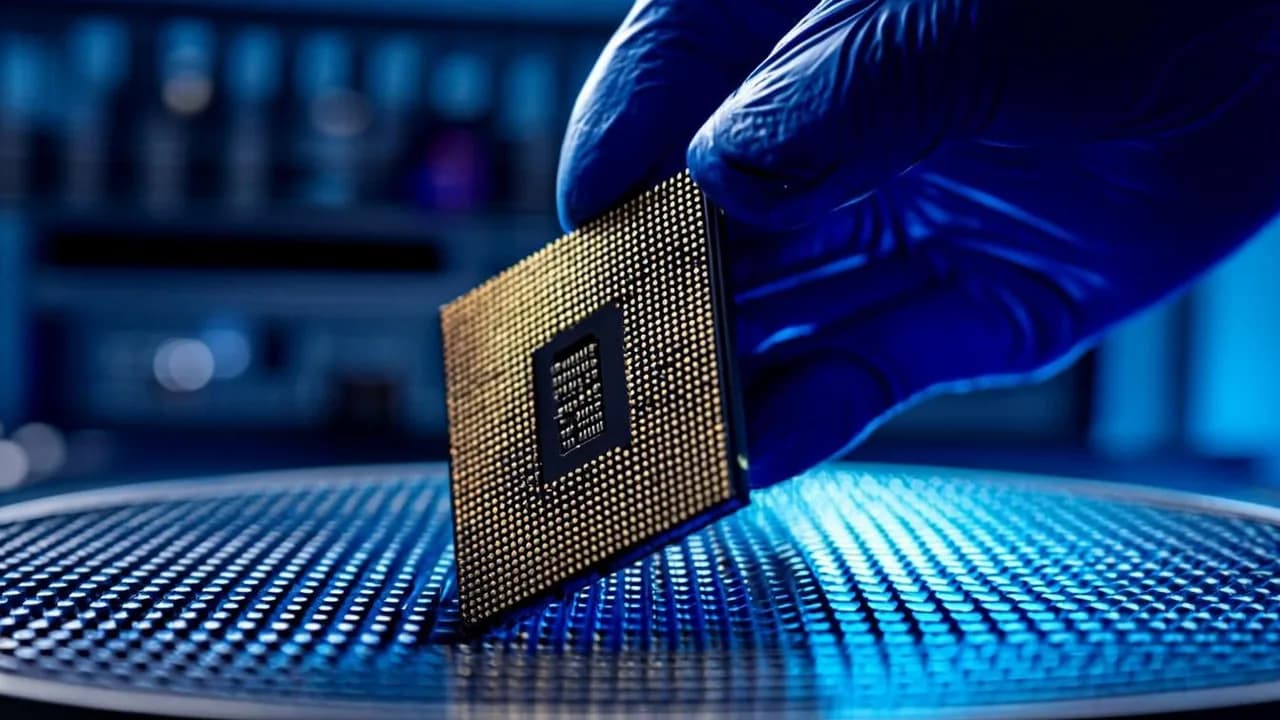
The AMD Q3 2026 earnings report lands tonight — Tuesday, Nov 3 — after the market close, per its investor-relations notice, and the AI chip trade will be watching two numbers before anything else: whether revenue lands near the $13.1 billion analysts model, up roughly 42% year over year, and what the data-center GPU outlook says about demand into 2027. Wall Street's earnings bar sits at $1.93-$1.95 per share, according to GuruFocus and Futu previews.
Timing gives the print extra weight. AMD steps up barely a week after a tech selloff that erased roughly $1 trillion of market value in a single session, with the Nasdaq falling 1.1% on Monday as Nvidia dragged the index lower, per AP. When does AMD report Q3 2026 earnings? At the worst possible moment in the sentiment cycle — which is also why the answer will travel further than an ordinary quarterly beat.
When does AMD report Q3 2026 earnings — and what matters
The calendar is straightforward: results after the close on Nov 3, with the usual conference call to follow and shares repricing in after-hours trade. What matters more is the agenda. Previews converge on two swing factors, per CoinDCX's earnings preview: the ramp of the Helios rack-scale AI platform and the data-center GPU outlook — the forward guide that decides whether customers are still expanding orders or merely fulfilling them.
Rack-scale systems change the conversation from chips to systems. Helios positions AMD to sell entire AI infrastructure racks rather than individual accelerators, which raises the revenue content of each win but also concentrates it: a delayed deployment is no longer one socket slipping a quarter, it is a full rack slipping one. That is the double-edged nature of tonight's guide, and it is why the stock's reaction may hinge less on the reported quarter — which analysts already expect to be strong — than on one paragraph about the future.
Listening guidance for the call is simple. Watch the first question — analysts typically lead with the swing factor — and the language around supply: whether Helios capacity is sold out, merely committed, or still being allocated. Those adjectives have historically moved the stock more than the earnings line, because they translate directly into next year's revenue visibility.
The AMD Q3 2026 earnings bar: $13.1 billion and a 42% climb
The reported numbers have a clear shape. Analysts model roughly $13.1 billion of Q3 revenue, up about 42% year over year, with EPS of $1.93-$1.95, per GuruFocus and Futu. For most companies a 42% growth rate would be the story; for AMD it is merely the baseline the market has already priced.
The engine behind that baseline is the data-center segment. AMD's data-center revenue climbed 107% year over year to $6.7 billion last quarter, driven by EPYC server processors and Instinct accelerators, per Barchart's preview. Sustaining triple-digit growth gets harder as comparisons grow, which is precisely why the sequential trajectory — and any commentary on supply, customer concentration and deployments — will be parsed line by line tonight.
The relative stakes are high. AMD is the credible second supplier in a market where the first supplier has been the market itself, and every quarter of data-center momentum is read as evidence that AI hardware demand is broadening beyond a single vendor. A beat confirms the broadening; a stumble hands the concentration argument the microphone.
A beat against that bar, in isolation, will surprise no one. The market's real question is whether the company guides the December quarter along the trajectory the numbers imply — the point at which a strong reported quarter either compounds into a credible growth story or stalls into peak-growth caution. The previews frame the guide, not the print, as the event.

Why an 11% slide sets an interesting stage
The setup is unusual. AMD shares slid about 11% into the print amid the broader AI selloff, per StocksDownUnder — a de-rating that happened before anyone saw the quarter. That matters for the reaction math: expectations into the close are lower than they were two weeks ago, so the same results can produce a different verdict. A market that has already sold the news leaves less news to sell.
Context explains the slide. Meta's reported talks to spend billions on Google TPUs — Meta's TPU talks that shook Nvidia — cracked the assumption that hyperscaler spending flows automatically to Nvidia, and by extension reframed the whole accelerator market as more contested than assumed. Then the widening chip selloff took the entire sector lower as AI leaders themselves called for caution about the pace of investment. Monday's 1.1% Nasdaq decline, with Nvidia the largest drag, capped the trend on earnings eve.
An 11% de-rating also changes the denominator of success. The stock no longer needs a blowout to score: results that merely confirm the demand narrative can restore multiples that two weeks of selling removed. That asymmetry is what previews mean when they describe the setup as interesting — the bears have already spent their ammunition, and the bulls still hold their guide.
Underneath the sentiment sits a very large number: five hyperscalers have committed $800.6 billion to AI spending in 2027, the figure we examined in big tech's $800 billion AI bet. AMD's guide tonight is one of the few direct datapoints on whether that commitment is turning into orders on schedule.
Customer concentration is the undertone beneath every scenario. A market where a handful of hyperscalers commit enormous infrastructure budgets creates demand that is vast but lumpy, and every supplier in the chain reports against the same order book. AMD's numbers are effectively a second reading of data investors have largely seen through Nvidia's tape: if both tell the same story, the narrative holds.
What the print says about AI chip demand
Treat tonight as a demand survey with a stock attached. If the data-center guide extends the 107% growth trajectory and Helios deployments stay on schedule, the market gets confirmation that the AI hardware order book is intact — and the past two weeks of selling start to look like positioning rather than deterioration. If the guide is merely in line, expect the conversation to stay focused on pricing power and customer concentration, the two areas where the bears have been loudest.
The previews frame the print as a referendum on breadth. Barchart's analysis emphasizes the EPYC and Instinct mix; CoinDCX's centers on Helios; Yahoo Finance's preview positions AMD as the cleanest read on second-source demand in accelerators. Analysts estimate the market can absorb a strong-but-unspectacular quarter — what it cannot easily absorb is a guide that contradicts the $800 billion spending narrative, because so much else in the sector is priced off it.
Either way, the after-hours move will over-communicate. Thin liquidity outside regular hours plus a crowded, recently-wounded shareholder base is the recipe for exaggerated reactions in both directions — which is precisely why the disciplined read is to wait for the call transcript and the guide, not the first tick.
What this means for you
If you own AMD, the practical advice is about process, not prophecy. Decide before the print what would change your thesis — a data-center guide that decelerates, Helios delays, or commentary on customer concentration — and measure the results against that list rather than against the after-hours price. One quarter at a 42% growth rate does not make or break a multi-year AI buildout, but a broken guide can reprice a stock for months — and an intact guide can repair two weeks of damage in a night.
If you are watching the AI trade more broadly, tonight is the second of three readings this cycle: Amazon's capex reset, AMD's demand check, and the hyperscaler guidance that follows. The question the market is really asking is whether $800 billion of committed spending converts into revenue on schedule. AMD's data-center segment is where that question gets its sharpest answer, because rack-scale wins convert directly into visible deployment schedules rather than vague intent. Our technology desk will track the after-hours tape tonight.
And if you buy AI hardware rather than stocks, the takeaways are supply-side. Rack-scale platforms like Helios shift procurement from chips to integrated systems with longer lead times and fewer second sources. For IT buyers, that argues for qualifying alternatives early, locking delivery windows in contracts, and treating availability — not list price — as the binding constraint through 2027. The quarter everyone is watching tonight will not settle the AI debate; it will only price the next three months of it. That, in this market, is enough to move.



Comments(0)
Share your thoughts. Comments are moderated and links are not allowed.
No comments yet. Be the first to share your view.
Add a comment