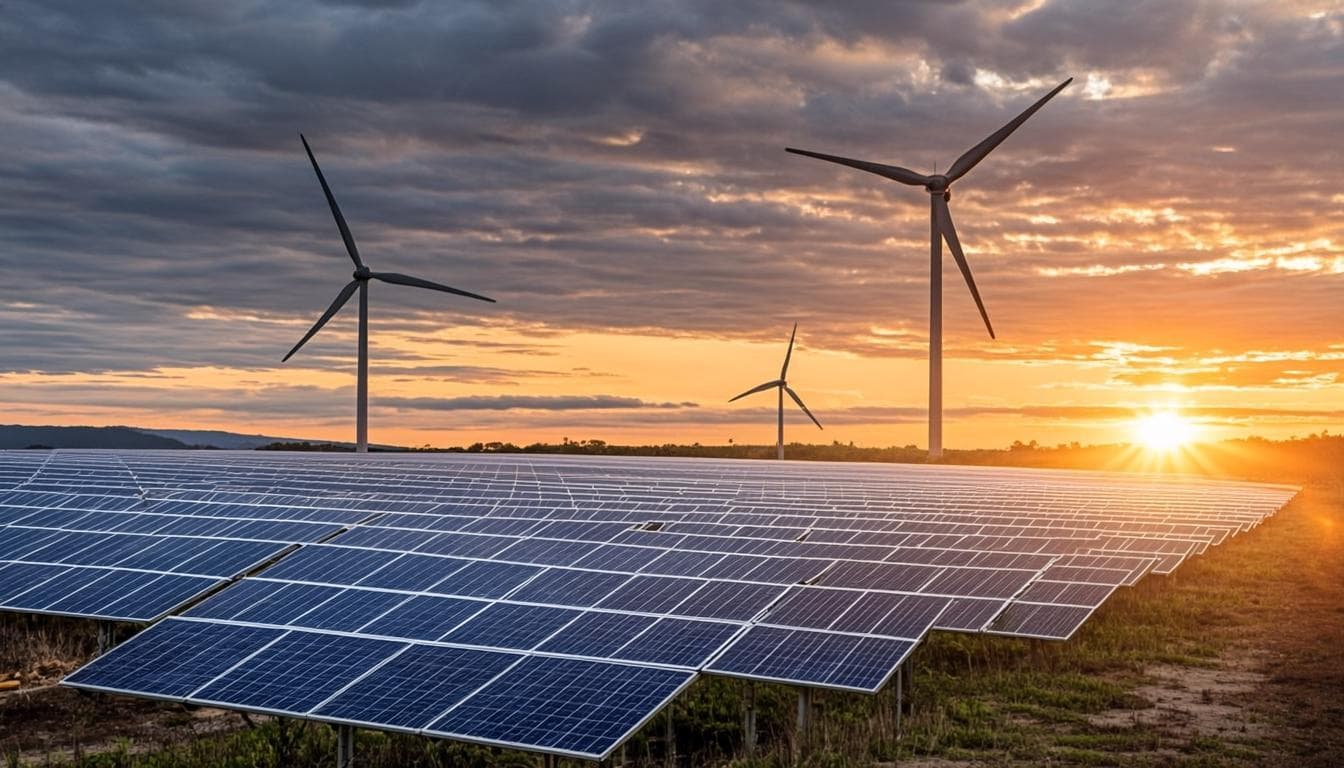
The center of gravity in the global energy transition is shifting south. Emerging economies accounted for the largest share of new renewable capacity added worldwide over the past year, according to industry trackers, driven by falling technology costs and surging electricity demand. The milestone matters less as a statistic than as a signal: the countries where almost all future demand growth will occur have stopped treating clean energy as an imported cause and started treating it as the cheapest way to build a power system.
For decades, clean energy investment was concentrated in wealthy economies. That pattern has broken. Solar in particular has become the default choice for new power generation across much of Asia, Africa and Latin America, outcompeting fossil alternatives on cost in a growing majority of markets. The revolution is not arriving by ideology; it is arriving by invoice.
The consequences reach beyond the power sector. They reshape the investment case for clean energy globally, redraw the map of energy diplomacy, and raise a harder question for the decade ahead: whether grids, storage and institutions can absorb new supply fast enough to outpace demand growth. This piece examines the economics behind the shift, the financing that follows, and the bottlenecks that decide the pace through 2026–2027.
Key Takeaways
- Emerging economies installed the largest share of new renewable capacity worldwide over the past year, according to industry trackers.
- The shift is driven by arithmetic more than policy: solar has become the default choice for new generation across much of Asia, Africa and Latin America, outcompeting fossil alternatives on cost in a growing majority of markets.
- The binding constraints have moved from generation economics to grid infrastructure and storage; developers say the hard part is now delivery, not the power plant.
- Financing remains the critical variable, with development institutions de-risking projects and institutional investors funding portfolios of operating assets.
Economics Drives the Shift
The transformation is being driven less by policy than by arithmetic. Solar module prices have fallen to levels that make new coal and gas plants difficult to justify on economic grounds in many regions, even where financing costs are high. Developers report that the binding constraints are now grid infrastructure and storage, not generation economics.
The mechanics of cost-competition deserve attention, because they explain why the shift is accelerating. A solar plant has near-zero marginal cost: once built, sunshine is free, which means every unit of solar generation displaces the most expensive fuel on the system. In fast-growing economies where peak demand arrives in the evening and air-conditioning loads stress the grid, utilities have learned that renewables plus storage can be cheaper than building new thermal capacity — and faster to commission, which matters when blackouts carry political costs.
Cost declines have compound effects. Cheaper modules mean bankable projects at smaller scale, which opens the market to distributed commercial and industrial buyers, not just state utilities. That, in turn, creates local installation industries — jobs, distributors, maintenance firms — that build constituencies for the transition that no climate policy could manufacture.
Battery costs are falling in parallel, and hybrid renewable-plus-storage projects are increasingly winning competitive tenders. Grid operators are investing in transmission at record levels to connect resource-rich regions to demand centers. Analysts describe the resulting dynamic as a race between two curves: the falling cost of supplying clean electricity and the rising cost of moving it to where people live.
Why Emerging Markets, and Why Now
History explains the inflection. In the transition's first two decades, clean energy was effectively a rich-country project: subsidies, feed-in tariffs, and mandates could be afforded where electricity was abundant and demand was flat. Emerging economies watched, priced the technology, and waited. The waiting ended when the price crossed the threshold at which renewables beat the alternative without subsidy.
Electricity demand growth does the rest. In mature economies, new generation competes mostly with existing plants; in emerging economies, it competes with unmet demand — factories that want reliable power, cities that are adding air-conditioning, rural regions still awaiting first connections. Analysts note that in this context every technology choice is a system-defining decision: what is built in the 2020s will run for decades.
Traditional energy exporters are adapting too. Several Gulf producers are channeling hydrocarbon revenues into domestic clean energy and hydrogen projects, positioning themselves as players in the future energy system rather than casualties of it. Their state investment funds have become some of the most active financers of renewable portfolios abroad, a strategic hedge that market watchers read as belief in the direction of travel.
The Investment Landscape
Financing remains the critical variable. International development institutions have expanded blended-finance programs to de-risk projects in frontier markets, and private capital is following. Institutional investors, hungry for long-duration income streams, are funding portfolios of operating renewable assets.
The structure of that capital matters. A single wind farm in a frontier market is a risky proposition; a diversified portfolio of hundreds of operating assets with contracted cash flows is a bond-like product that pension funds can hold. Aggregation — bundling projects into vehicles that institutional buyers recognize — has quietly become the most important financial innovation of the transition, more consequential than any single technology breakthrough.
Currency risk is the part outsiders most often underestimate. Projects earn revenue in local currency while much of the debt is dollar-denominated; when exchange rates move, otherwise sound projects become distressed. The response has been financial engineering: local-currency lending windows at development banks, guarantees that absorb devaluation risk, and pricing models that build in buffers. Analysts describe the frontier-market cost of capital, not the cost of hardware, as the largest remaining gap between the transition's potential and its delivery.
A Bumpy Road Ahead
Challenges persist. Grid bottlenecks, permitting delays and currency volatility continue to slow projects. And electricity demand is growing so fast in many emerging economies that fossil generation keeps rising even as renewables surge — the transition is a race, not a walk.
The race framing deserves emphasis. Analysts note that in several large emerging economies, record renewable additions and record coal generation coexist, because demand absorbs both. The emission arithmetic, in other words, is decided by the margin between the two curves, and the margin varies country by country with demography, industrial policy and efficiency.
Scenarios for 2026–2027
Three paths frame the outlook. In the consolidation scenario, current trends hold: costs keep falling, financing broadens, and emerging economies extend their lead in new capacity while demand growth absorbs much of the supply. In the acceleration scenario, storage costs decline faster than expected and grid investment catches up, letting clean supply actually displace fossil generation rather than merely accompany it. In the friction scenario, currency stress, grid delays or political reversal slow the build-out, and the race tightens. Market watchers describe the second as plausible and the third as underpriced — infrastructure, not ideology, has become the transition's binding constraint.
FAQ
Why are emerging economies leading the energy transition?
Because the economics now work where demand growth is. Solar in particular has become the default choice for new generation across much of Asia, Africa and Latin America, outcompeting fossil alternatives on cost in a growing majority of markets — even where financing costs are high. Where demand is growing fastest, the cheapest way to add power is increasingly clean.
What is holding the transition back?
Delivery, not generation. Developers report the binding constraints are now grid infrastructure and storage. Transmission investment is running at record levels, but grid bottlenecks, permitting delays and currency volatility continue to slow projects, and demand is growing so fast in many markets that fossil generation keeps rising even as renewables surge.
How are these projects being financed?
Through layered risk-sharing. Development institutions use blended finance to de-risk projects, private capital follows, and institutional investors buy portfolios of operating assets that behave like long-duration income streams. The remaining frontier is the cost of capital in local currency, which analysts see as the biggest gap between potential and delivery.
Does this mean fossil generation is declining in these countries?
Not yet, in most of them. Record renewable additions and rising fossil generation coexist because demand absorbs both. The transition in emerging markets is a race between how fast clean supply can be added and how fast demand grows — the emissions arithmetic is decided by the margin between those curves.
The Bottom Line
The energy transition's most important change in years is geographic. The markets that will define the shape of the global power system this century — the fast-growing, demand-hungry economies of the South — have stopped being the transition's audience and become its engine. The direction is unmistakable: as one energy executive observed, the question in emerging markets is no longer whether clean energy will dominate new investment, but how quickly the system can absorb it.
The pace, however, will be set by unglamorous things: transmission lines, permitting offices, currency hedges and storage. For investors, the signal is to focus on the delivery chain as much as the generation chain. For policymakers, the task is to make the absorptive capacity of the system grow as fast as its supply.
Watch through 2026–2027 whether record renewable additions begin to displace fossil generation outright, or merely chase it. That margin — not the headline capacity numbers — is where the climate and investment story of this decade will be decided.



Comments(0)
Share your thoughts. Comments are moderated and links are not allowed.
No comments yet. Be the first to share your view.
Add a comment